
Think your freelance proposal is just a price list? Think again.
A winning proposal is really a story. It’s the story of how you’re going to step in and solve your client’s very specific problem. It’s your first real chance to build trust, show off your value, and set a professional, confident tone for the whole project.
The best ones I’ve ever seen (or written) are deeply personal. They prove you get it—you understand their goals before you’ve even signed a contract.
Your Proposal Is More Than Just a Price Tag

It’s time for a mental shift. So many freelancers see proposals as a chore—just a quote to fire off as fast as possible. That’s a massive missed opportunity. Your proposal is your opening act, your first chance to really prove you’re the expert they need.
A killer proposal does way more than list tasks and costs. It tells a story. It shows the client you didn’t just hear their request, you actually understand the business challenge behind it. This is how you go from being a simple task-doer to a strategic partner.
Stand Out in a Crowded Room
The freelance world is buzzing. It’s a $1.2 trillion sector of the US economy, and with 84% of companies outsourcing content, the demand is definitely there. But so is the competition. A generic, copy-paste proposal is going straight to the trash folder.
To really stand out, your proposal has to feel like it was made just for them. It needs to show you’ve done your homework on their company, their customers, and what’s keeping them up at night. That kind of effort builds instant trust and makes you look like a pro.
A great proposal is a sales document disguised as a plan. Its primary job isn't to state your price, but to justify it by connecting your services directly to the client's success.
From Chore to Strategic Weapon
Changing your mindset is the first real step. When you start seeing proposals as a strategic tool instead of just admin work, everything changes. To really take it to the next level, it helps to brush up on some essential sales consultant skills.
This approach pays off in a few huge ways:
- Builds Instant Trust: A thoughtful proposal shows you’re invested in their success, which is the foundation of any great client relationship.
- Looks Damn Professional: It sets the tone for the entire project, positioning you as an organized, detail-oriented expert right from the start.
- Kills Confusion Early: By clearly defining the scope and what you’ll deliver, you shut down scope creep before it even starts and manage expectations from day one.
At the end of the day, a winning proposal is the first building block of a lasting partnership. If you want to dig deeper into that foundational work, check out our guide on how to build strong client relationships from the get-go.
Laying the Groundwork Before You Write
Let’s be honest: the best freelance proposals are won before you even open a new document.
Sending a proposal cold, without doing your homework, is like showing up to an exam you haven’t studied for. You might squeak by, but you’re definitely not acing it. The real magic happens in the prep work. This is where you turn a generic template into a custom-tailored solution that makes the client feel completely understood.
This isn't just about skimming their project brief. It’s about becoming a mini-expert on their company, their industry, and their customers. Your goal is to get to the heart of the real problem behind their request. When you do that, you stop being just another freelancer and start becoming a strategic partner. That initial effort is what separates a pretty good proposal from a "we have to hire them" proposal.
Become a Client Detective
Before you even dream of writing about solutions or pricing, you need to put on your detective hat and do some serious digging. Your mission is to understand the client’s world so intimately that your proposal speaks their language and solves problems they haven’t even fully articulated yet.
Start with their digital footprint. Scour their website, paying close attention to the "About Us" page, their mission statement, and any case studies you can find. This tells you what they care about and how they talk about themselves. From there, jump over to their social media, especially LinkedIn, to get a feel for their company culture, recent wins, and who the key players are.
A quick pre-proposal research checklist looks something like this:
- Company Mission & Values: What's their north star? Aligning your proposal with their core purpose is a power move.
- Recent Wins: Did they just launch a new product, win an award, or get some press? Dropping in a quick congrats shows you’re paying attention.
- Their Audience: Who are they actually selling to? A proposal for a B2B tech company will feel totally different from one for a consumer-facing lifestyle brand.
- The Competition: Who are they up against? Knowing this helps you frame your ideas as a way to give them a real competitive edge.
The Power of the Discovery Call
As great as online stalking is, nothing beats a real conversation. A discovery call (or even a thoughtfully crafted questionnaire) is your single biggest chance to unearth the juicy details that will make your proposal impossible to ignore. This is where you get past the surface-level "what" and dive deep into the strategic "why."
Your goal here isn't to pitch yourself—it's to listen. Ask smart, open-ended questions that get the client talking about their headaches, their big dreams, and what a huge win would look like for them.
Don't just ask, "What do you need?" Instead, try asking, "What business goal are you trying to achieve with this project?" The first question gets you a to-do list. The second gives you the context to propose real, undeniable value.
This call is also your chance to show off the homework you've already done. Something as simple as, "I saw on your blog that you're focused on expanding into the European market this year. How does this project fit into that initiative?" instantly proves you're engaged and already thinking like a partner.
Documenting Your Findings
All this amazing intel is useless if you don't wrangle it. This is where a clear, concise project brief comes into play. It doesn’t matter if the client gives you one or if you create it yourself based on your discovery call—this document is your blueprint. It gets everyone on the same page about the project's goals, scope, and desired outcomes before you sink hours into writing the proposal.
If you need a solid starting point, you can find a helpful creative brief template to help you structure all your findings.
Putting in this time upfront is what sets the stage for a winning proposal. You gather the insights needed to write something that doesn’t just list services, but presents a compelling, can’t-say-no solution to a problem you now deeply understand. This is how you stop competing on price and start winning on value.
Structuring Your Proposal for Maximum Impact
A winning freelance proposal isn't a resume or a price list. Think of it as a guided conversation—a story where the client is the hero, and you’re the trusted guide leading them to success.
Forget those one-size-fits-all templates. A strategic structure is your best tool for getting noticed and, more importantly, getting that "yes."
The flow is everything. A weak proposal jumps straight into your credentials or the price tag. A powerful one starts by showing the client you get them, then lays out a clear plan to make their world better.
Start with a Personalized Hook
Your intro is your first, and maybe only, chance to grab their attention. Don't waste it with a generic "Dear Sir/Madam" or a boring summary of what you do. The goal here is an immediate, personal connection that proves this proposal wasn't just copy-pasted.
Reference something specific you talked about on your discovery call. Mention a recent company win you found on their blog. Lead with a strong statement that shows you’ve already been thinking deeply about their core challenge.
This isn’t just a formality; it’s the opening scene of your project's story. If you're looking for fresh ideas on how to build that narrative, the principles of effective storytelling in marketing can be a goldmine.
Prove You Understand Their Challenge
This is probably the most critical part of your entire proposal. Before you even whisper a word about solutions, you have to prove you have a deep, genuine understanding of their problem.
This section isn't about you at all. It’s a mirror.
Summarize their current situation, the specific pain points they're dealing with, and the goals they're trying to hit. Use their own language back to them. This shows you weren't just nodding along on the call—you were listening on a strategic level.
A client doesn't hire you for tasks. They hire you to solve a problem and deliver an outcome. Your proposal has to prove you understand that problem better than anyone else.
This groundwork is non-negotiable. Before you even think about writing, you need to understand the client’s world from the inside out.
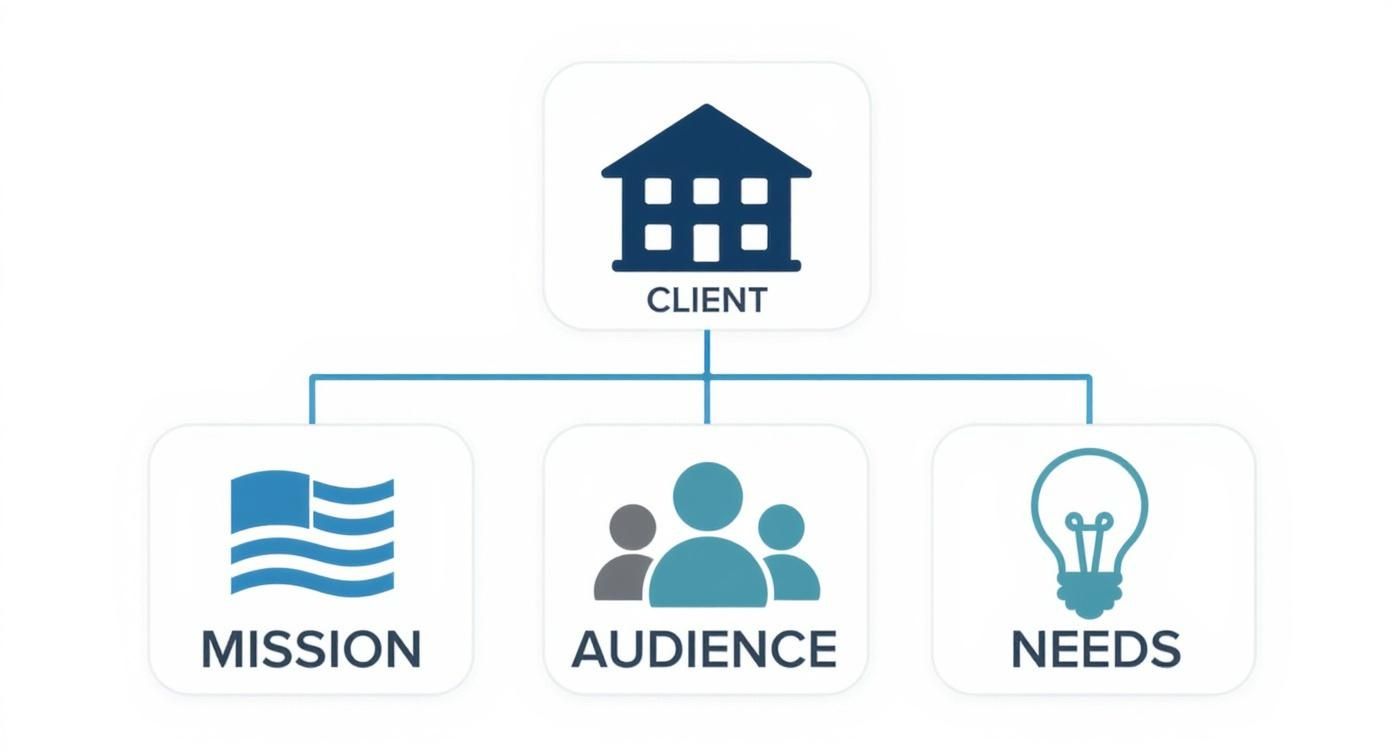
Starting with their mission, audience, and needs is the foundation for a proposal that actually connects.
Present Your Compelling Solution
Okay, you've set the stage by defining the problem. Now it's time to reveal the solution.
This is where you detail your unique approach, but be careful. Avoid just listing your services like a menu. Instead, frame every part of your plan in terms of client benefits.
For example, instead of saying, "I will write five blog posts," try this: "We will develop a five-part blog series targeting key SEO terms to attract your ideal customer. This will establish your brand as an authority and drive organic traffic directly to your high-value service pages."
See the difference? One is a task. The other is a business outcome.
Define the Scope and Investment Clearly
Clarity is your best friend when you get to the nuts and bolts.
Your Scope of Work needs to be crystal-clear. Use bullet points to outline every single tangible deliverable, from the number of revisions to specific project milestones. This is your best defense against scope creep down the road.
Finally, present the Investment section with confidence. Don't just slap a price on it; label it an "Investment" or "Project Fee." This small tweak reframes the cost from an expense into a strategic move that will generate a return.
If you’ve done your job in the previous sections, the price won't be a shock. It will feel like the logical conclusion to the value you've already demonstrated.
Here’s a quick breakdown of how to shift your focus from yourself to the client, which makes all the difference.
Anatomy of a Winning Proposal Structure
| Proposal Section | Weak Approach (Focus on You) | Strong Approach (Focus on Client Value) |
|---|---|---|
| Introduction | "My name is [Your Name] and I offer graphic design services." | "Following our conversation about boosting your online engagement, I've developed a plan…" |
| Solution | "I will provide a new logo, brand guide, and social media templates." | "We will create a cohesive brand identity that attracts your target audience and builds brand recognition." |
| Scope | "Five logo concepts, three rounds of revisions." | "Deliverables: A complete brand identity package including primary logo, variations, and a full style guide." |
| Pricing | "Price: $2,500" | "Investment: A one-time project fee of $2,500 to revitalize your brand presence." |
This simple shift in perspective—from "what I do" to "what you get"—is what separates proposals that get ignored from those that get signed.
Defining Your Price and Project Scope
Alright, let's talk about the part of the proposal everyone secretly dreads: the money talk. This is where the numbers hit the page, and it feels like a high-stakes moment. So many creatives I know get stuck here, totally paralyzed by the fear of quoting too high and scaring off a great client, or going too low and ending up resentful.
But here’s the thing: framing your price and scope isn’t a wild guess. It's a strategic move that shows you're a confident professional who values your work and, just as importantly, respects the client's investment.
Getting this right is how you stop being a glorified temp trading hours for dollars and start getting paid for the value you create. It's also your best line of defense against the dreaded scope creep—you know, those little "can you just…" requests that slowly suck the life and profit out of a project. A crystal-clear scope is the bedrock of a healthy, happy client relationship.
So, How Should You Price Your Work?
Before you even think about a number, you need to decide how you're going to charge. There’s no single right answer here. The best model really depends on the project, the client, and your personal workflow.
Most freelancers lean on one of these common pricing models. Let's break them down.
Freelance Pricing Models Compared
| Pricing Model | How It Works | Pros | Cons |
|---|---|---|---|
| Hourly Rate | You bill for every hour you spend working on the project. | Simple for everyone to understand. Good for ongoing work or projects with a fuzzy scope. | Punishes you for being fast and efficient. Clients might worry about hours racking up. |
| Per-Project Fee | You charge a single, fixed price for the entire project from start to finish. | Clients love the cost certainty. Rewards efficiency and focuses on the final outcome, not the process. | Requires you to estimate your time and effort accurately. Scope creep can kill your profit margin. |
| Value-Based | You price your work based on the tangible business results it will deliver for the client. | Highest earning potential by far. Positions you as a strategic partner, not just a service provider. | Requires a deep understanding of the client's business and confidence in your ability to deliver ROI. |
So, what does this look like in the real world? Compensation for freelance proposal writers, for instance, is all over the map. While the average hourly rate hovers around $23.27, many seasoned pros charge on a per-project basis, with fees anywhere from $40 for a quick job to over $51,000 for massive, complex bids. You can explore the salary potential for freelance writers on ZipRecruiter to get a feel for the market.
Stop Scope Creep In Its Tracks
Scope creep is the silent killer of freelance projects. The only way to win this fight is to draw your lines clearly and firmly right inside the proposal. Think of this section as the "rules of the game" that everyone agrees to before kickoff.
Your proposal's scope section isn't a restriction; it's a clarification. It manages expectations and creates a shared understanding of what "done" looks like, preventing future misunderstandings.
Get specific. Leave absolutely no room for interpretation. When you clearly list what's included, you're also subtly defining what's not.
To build a scope that's practically bulletproof, you need to detail:
- Key Deliverables: What is the client actually getting? Don't just say "a new logo." Specify "3 initial logo concepts, 1 final logo in vector format (AI, EPS, SVG), and a brand style guide PDF."
- Revision Rounds: How many chances do they get to provide feedback? Be explicit. "Two full rounds of revisions are included." Then, define what happens if they need a third.
- Project Timeline: Lay out the key milestones and estimated delivery dates. This isn't just a schedule; it's proof that you have a professional process.
- Exclusions: Sometimes it helps to spell out what you're not doing. For example, "This quote does not include stock photography licensing or font licensing fees."
Putting this level of detail together takes a bit of practice. If you want to go deeper, our guide on how to define project scope has some great, actionable steps to help you lock things down.
The Smart Way to Present Your Price: Tiered Packages
Instead of just dropping a single price in their lap, try offering tiered packages. This is a classic psychological technique that works wonders. It instantly shifts the client's thinking from, "Should I hire this person?" to, "Which of these options is the best fit for me?"
By creating a Basic, Standard, and Premium tier, you give the client a sense of control and choice. The middle option usually looks like the best value, often nudging clients to invest a bit more than they might have with a single, take-it-or-leave-it price. This simple trick frames you as a flexible partner who's ready to find a solution that works for them.
Polishing and Presenting Your Proposal
You’ve done all the heavy lifting. The research, the strategy, the pricing—it's all there. But don't trip at the finish line. A brilliant proposal can be completely sunk by sloppy mistakes and a clunky presentation.
This final polish isn't just about looking pretty. It's about sending a clear message: you're a detail-oriented pro who respects the client's time. A clean, error-free document builds trust before they even see the price tag.
Flawless Editing Is Non-Negotiable
Seriously. There's zero excuse for typos or grammatical errors in a document that’s supposed to highlight your professional value. A single mistake screams "lack of attention to detail," and that's the last impression you want to leave.
First, the basics. Run your proposal through a grammar checker like Grammarly or the Hemingway App to catch the easy stuff. Then, read it out loud. It feels weird, but it forces you to slow down and catch awkward phrasing that your brain just skims over when reading silently.
The best trick? Step away for at least an hour—or even better, overnight. Coming back with fresh eyes will make any lingering mistakes jump right off the page. If you really want your words to land, focus on mastering powerful messaging in your proposals to make sure your value is crystal clear.
Design It for Readability
You don't need to be a graphic designer, but you do need a proposal that’s clean, branded, and easy to scan. A giant wall of text is a one-way ticket to the "I'll read this later" pile, which often means never.
Jump into a tool like Canva or PandaDoc and create a simple, branded template. They have pre-made layouts that look great and are easy to customize. Remember, good design is a preview of the quality you deliver. Many of the same visual rules apply here as they do for your portfolio—check out these portfolio presentation tips for more on making a strong visual impact.
Your proposal's design is its body language. A clean, organized layout communicates professionalism and clarity, while a messy one screams chaos. Make sure it reflects the quality of your work.
Your Final Pre-Send Checklist
Before that finger even thinks about hitting "send," run through this quick checklist. It's your last line of defense.
- Correct Names: Is the client's name spelled right? Their company's name? Get it wrong, and you look careless.
- Placeholders Removed: Did you remember to swap out all the
[Client Name Here]text? We’ve all been there. - Links Work: Click every single link. Make sure they go exactly where they're supposed to.
- Numbers Add Up: Double-check your math. All pricing, totals, and timelines need to be 100% accurate.
- File Format: Are you sending a PDF? Is that what they asked for? Don’t make them convert a file.
Choosing Your Delivery Method
How you send the proposal actually matters. Sure, you can just attach a PDF to an email, and sometimes that's fine. But dedicated proposal software like PandaDoc, Proposify, or Bonsai gives you a serious leg up.
These tools are your secret weapon. They tell you when the client opens the proposal, how many times they look at it, and even which sections they spend the most time on. That's pure gold. It helps you time your follow-up perfectly and gives you intel on what they care about most before you even hop on a call.
So you hit "send" on that big proposal. Now what?
That moment feels like the finish line, but it’s really just the starting gun for the next leg of the race. The silence on the other end can be absolutely deafening, I know. But having a solid, professional game plan for your follow-up keeps you from nervously refreshing your inbox. It shows the client you’re on top of your game.
Don't just sit there and hope. A quick, well-timed check-in can be the little nudge that bumps your email to the top of their list. The trick is to be helpful, not a pest. Give them some breathing room—I find that waiting 3-5 business days is the sweet spot. It's enough time for them to have a look without you breathing down their neck.
How to Master the Follow-Up
When you do reach out, keep it short, friendly, and focused on them. Drop the generic "Just checking in!" line. Instead, your goal is to reopen the conversation by offering help.
Here’s a simple script I’ve used that works wonders:
Subject: Quick question about the [Project Name] proposal
Hi [Client Name],
Hope you’ve had a great week.
Just wanted to quickly follow up on the proposal I sent over on [Day]. Did you have any questions about the project scope or the solution I laid out? Happy to hop on a call to clarify anything.
Best,
[Your Name]
See? It's polite, straight to the point, and gets the ball back in their court without any pressure. If you still don't hear anything, you can try one more follow-up about a week later. After that, it's best to move on. Sometimes, radio silence is its own kind of answer.
Navigating Negotiations Like a Pro
What if they reply but want to haggle on the price? First off, take a breath and smile. This is actually great news! It means they're serious and want to find a way to work with you. The secret here is to steer the conversation toward value, not just the price tag.
Resist the urge to immediately slash your rates. Instead, start by exploring the project scope. Ask questions to figure out what their budget constraints really are.
You could say something like, "I totally understand that the budget is a key factor. To get closer to your target price, what if we adjusted the scope a bit? For example, we could start with three core deliverables instead of five. How would that work for your team?"
This approach keeps your value intact while showing you’re flexible. You instantly become a problem-solving partner, not just a vendor, which is exactly where you want to be.
Turning a "No" into a Future "Yes"
Sometimes, no matter what you do, the answer is just "no." It stings, but how you handle it matters. Always respond with grace.
Thank them for their time and for considering you. A simple, professional reply can leave the door wide open for another shot down the road. Let them know you'd love to collaborate if another project comes up that’s a better fit.
You'd be surprised how often a positive final impression leads to a referral or a call a few months later. Every proposal—whether it gets signed or not—is a chance to grow your network and sharpen your skills.
Burning Questions About Freelance Proposals
You've got questions, I've got answers. When you're trying to figure out how to write a proposal that actually gets you hired, a few common sticking points always come up. Let's tackle them head-on.
How Long Should This Thing Be, Anyway?
Look, shorter is almost always better. I've seen the data, and proposals under five pages are 31% more likely to get the green light.
Your potential clients are drowning in emails and to-do lists. The last thing they want is a novel. Respect their time with a scannable, punchy document that gets straight to the good stuff.
Think of it this way: your proposal should be long enough to hit every key point but short enough to keep them hooked. It’s all about delivering value, not a massive page count.
How Fast Do I Need to Send It?
Speed is your secret weapon here. The numbers don't lie: winning proposals get sent out about 26% faster than the ones that get ignored.
My rule of thumb? Aim to have that proposal in their inbox within 2-3 days of your discovery call. It shows you’re on the ball, excited about the project, and ready to roll. You want to keep that momentum going from your initial chat.
What if I'm New and Have No Portfolio?
Don't panic. If you're just starting out, you can absolutely still put together a killer proposal. Instead of a portfolio full of past work, you're going to build trust in other ways.
- Create a Spec Project: Show, don't just tell. Whip up a sample piece of work that’s tailor-made for their specific problem.
- Lean on Testimonials: Got praise from a former boss, a college professor, or an old colleague? Use it! Quotes that speak to your skills and work ethic are pure gold.
- Flesh Out Your Plan: This is where you shine. Pour all your energy into the "Proposed Solution" part of your proposal. Show them you have a strategic, rock-solid plan just for them.
When you do this, you're proving your chops without needing a long list of clients. Your deep understanding of their challenge becomes the star of the show.
Ready to find clients who get excited about your creative work? Join Creativize to show off your portfolio, land high-quality local projects, and really start growing your freelance business. Get started on Creativize today.