

Finding any good gig really boils down to two things: building a solid foundation and then getting out there to chase opportunities. It's all about carving out your niche, putting together a portfolio that actually solves problems, and then using those assets to land work—whether that's on platforms or through your own network.
Build Your Foundation for Finding Great Gigs
Before you even think about pitching your first project, you’ve got to get your house in order. Just jumping into the market with no clear plan is like trying to build a house without a blueprint. It's messy, and you probably won't like the result.
The first, and maybe most important, step? Stop being a generalist. Seriously.
When you try to be everything to everyone, you end up being memorable to no one. Instead, get laser-focused. Are you a branding designer for direct-to-consumer coffee companies? A 2D animator for educational tech startups? The more specific you are, the easier it is for the right clients to find you and see you as an expert. That's how you start commanding higher rates and attracting much better work.
Your Portfolio Is Your Best Sales Tool
Your portfolio should never be a random dump of everything you've ever created. Think of it as a curated gallery that speaks directly to the problems your ideal client is facing. Every single piece should show off not just your skills, but your ability to get results.
Let’s be real: a client doesn't just want a cool logo. They want a logo that boosts brand recognition and actually helps them sell more stuff. You need to frame your portfolio pieces like mini case studies.
- The Problem: What was the client struggling with when they came to you?
- Your Solution: How did your work tackle that specific challenge head-on?
- The Result: What was the measurable outcome? More traffic? Higher conversion?
This little shift in thinking turns you from just another freelancer into a strategic partner they can't afford to lose. If you need some inspiration, check out these powerful creative portfolio examples that absolutely nail this approach.
Define Your Rates and Online Presence
Pricing your work can feel super awkward at first, but it's a non-negotiable part of building a career that actually lasts. Do some digging to see what others in your niche are charging, but whatever you do, don't sell yourself short. Your rates should reflect your expertise, the value you bring to the table, and your own financial goals.
And finally, your online presence is your digital storefront. It doesn't have to be some complex, multi-page behemoth. A clean, professional website or even a well-optimized profile on Creativize or LinkedIn can do the trick. The whole point is to make it dead simple for potential clients to see what you do, check out your work, and get in touch.
For a great guide on standing out, check out this resource on how to find a remote job you'll love. The freelance world is blowing up—some projections show that up to 50% of the U.S. workforce could be freelancing by 2025. There's a huge demand for specialized skills out there.
Win on Freelance Platforms and Job Boards
Online platforms can be a goldmine for finding your next gig, but let's be real—they're also packed with competition. The trick isn't to blast out fifty applications a day. It’s about being smart, standing out, and showing a client you’re the real deal before you even have a conversation.
Think of your profile as your digital storefront. It needs to be sharp and compelling.
Crafting a Winning Profile
Your profile is your first handshake, so don't phone it in. Ditch the boring list of skills and tell a story instead. Who do you help? What problems do you solve for them?
Instead of just saying "Graphic Designer," try something like, "Branding Specialist for E-commerce Startups Who Need to Stand Out in a Crowded Market." See the difference? That immediately speaks to a specific client with a specific need.
Your portfolio has to back this up. Don't just dump every project you've ever done. Curate the work that screams "I'm an expert in this niche." For each piece, add a bit of context: what was the client's problem, and how did your work deliver a solution? You're not just selling deliverables; you're selling results.
The visual below really breaks down the core elements you need to get right.
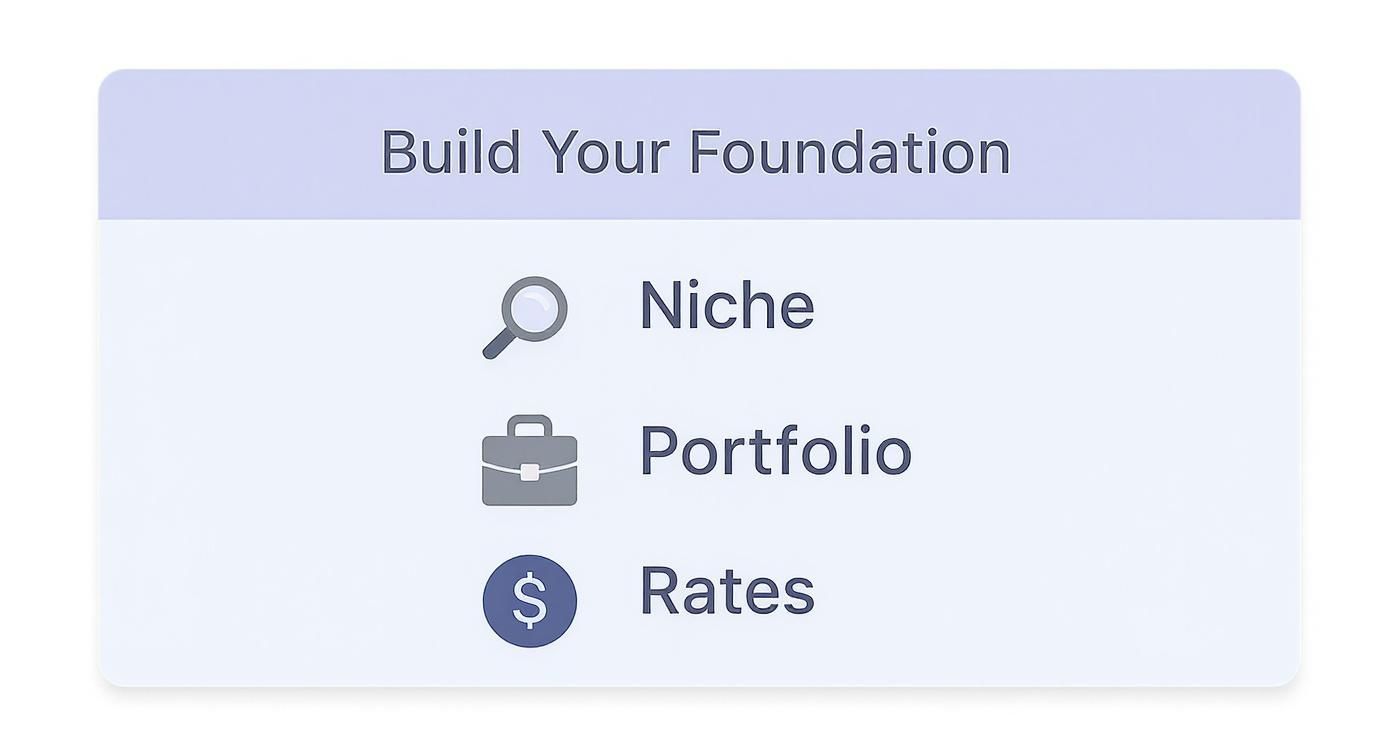
This graphic is a great reminder that a focused niche, a problem-solving portfolio, and confident rates are what make a profile work. Without them, you’re just another face in the crowd.
Now, I know platforms like Upwork can get a bad rap for a race-to-the-bottom mentality, but there are absolute gems on there if you know how to look. I landed some of my best early projects by learning to filter out the noise and zeroing in on high-quality posts. The secret is aggressive filtering and writing proposals that speak directly to the client's pain points.
The fastest way to get ignored on a job board is to use a template proposal. Clients can spot them from a mile away. Your pitch needs to prove you actually read and understood their project brief. Show genuine interest and expertise from the very first sentence.
Platforms like our own, Creativize, and other niche-specific job boards can be a game-changer. You'll often find less competition and more relevant opportunities. It’s just easier to land great work when you aren't fighting against thousands of generalists. For a deeper dive, check out our guide on how to get freelance clients for more strategies.
Platform-Specific Strategies
Every platform has its own vibe, and you need to play to its strengths. Fiverr, for example, is brilliant for "productized" services—think clearly defined packages like "I will design three social media templates." Upwork, on the other hand, is generally better for bigger, more complex projects.
You have to tailor your approach:
- Broad Platforms (Upwork, Freelancer): Your reputation is everything. Focus on getting those initial 5-star reviews, even if it means starting with smaller projects to build momentum and social proof.
- Niche Boards: Here, your portfolio does all the talking. These clients are looking for a specialist, so your work needs to immediately convince them you're the one.
- Community-Based Boards (e.g., Dribbble, Behance): Engagement is key. Become part of the conversation. Participate in the community to build trust before you even apply for a gig.
Top Freelance Platforms at a Glance
Choosing the right platform can feel overwhelming. This table breaks down a few of the big players to help you decide where to focus your energy based on your skills and what you're looking for.
| Platform | Best For | Typical Gig Value | Key Feature |
|---|---|---|---|
| Upwork | A wide range of skills, from development to design; hourly and fixed-price projects. | $ – $$$$ | Robust project management tools and payment protection. |
| Fiverr | Productized services and clearly defined, one-off gigs. | $ – $$$ | The "Gig" model makes it easy for clients to buy pre-packaged services. |
| Creativize | High-end creative talent, vetted projects, and direct client connections. | $$$ – $$$$ | A curated community model that focuses on quality over quantity. |
| Toptal | Elite, pre-vetted freelance talent, primarily in tech and finance. | $$$$ | Rigorous screening process ensures only the top 3% of applicants get in. |
| Dribbble | Designers and visual creatives looking to showcase their work and find project leads. | $$ – $$$$ | Strong portfolio focus and a dedicated job board for design roles. |
Ultimately, the best platform is the one where your ideal clients are hanging out. It might take a bit of experimenting to find your sweet spot, but putting in the effort to understand the nuances of each one will pay off big time.
Tap Into Your Network for Hidden Gigs

Sure, freelance platforms are great, but some of the absolute best gigs never even get a public post. They’re filled through word-of-mouth, quiet referrals, and solid professional relationships. This is the “hidden job market,” and it's where your network can really pay off.
The trick is to stop thinking of networking as a sales pitch. It’s not. It’s about making genuine connections and figuring out how you can help people. Forget the awkward elevator speech; just let your circles know what you do and who you’re great at helping.
Let Your Circles Know You're Available
First things first, start with the people who already know, like, and trust you. I’m talking about old colleagues, happy former clients, friends, even family. You never know who’s connected to someone who desperately needs your skills.
A simple, low-pressure email or a quick social media post can do the trick. You don't want to come off as begging for work. Instead, frame it as an exciting update. Share a recent project you’re proud of and casually mention you have room for similar work. It’s a subtle way to stay top-of-mind without making anyone feel pressured.
Leverage Industry Events and Local Meetups
Whether they're in-person or virtual, industry events are goldmines for making new connections. The goal isn't to walk away with a stack of business cards. It's to have a few real conversations.
When you meet someone interesting, be curious. Ask them about what they’re working on and the challenges they’re facing. This builds instant rapport and helps you spot problems you might be able to solve. Always follow up with a personalized note on LinkedIn, reminding them of your conversation.
The best networking happens when you’re not really “networking.” Just be curious, be helpful, and build relationships long before you actually need anything. That authenticity is what turns a casual contact into someone who champions your work.
Turning Past Clients Into a Referral Engine
Your happiest clients are your best marketers. Seriously. Someone who loved working with you is usually more than happy to recommend you to their own network, but you might need to give them a gentle nudge.
Don't just send the final invoice and ride off into the sunset. A few weeks after a project wraps, check in. See how things are going. If the feedback is glowing, that’s your moment to ask if they know anyone else who could use your help.
Make it incredibly easy for them. Give them a short, pre-written blurb about your services that they can just copy and paste. Learning how to build client relationships that last is how you create this kind of referral pipeline. It’s a strategy that turns a one-off gig into a steady stream of high-quality leads that come straight to you.
Craft a Pitch That Converts and Lands the Job
Finding that perfect gig is one thing, but turning that lead into a signed contract? That’s where the real magic happens. Your pitch is your first, and sometimes only, chance to prove you’re the right person for the job. It has to do more than just rattle off your skills—it needs to show you get the client's problem, maybe even better than they do.
Before a single word hits the page, you have to become a detective. Dig into the job posting and read between the lines. When a client says they need "a new website," what they're often really saying is, "Our sales are tanking, and we think our clunky old site is the culprit." Your pitch needs to speak to the sales problem, not just the website task.
Deconstruct the Client's Needs
A simple way to break it down is to look for three core components in the gig description. This little framework helps ensure you’re not just applying for a task, but actually presenting a solution.
- The Obvious Task: This is the thing they're explicitly asking for. Think "design five social media graphics." Easy enough.
- The Underlying Goal: This is the why behind the task. For example, "to drive engagement for our new product launch."
- Their Hidden Fear: This is the risk they’re trying to avoid. It’s often something like "wasting money on ads that don't perform" or "hiring another freelancer who blows past deadlines."
A killer pitch hits all three. You acknowledge the task, show you're aligned with their bigger goal, and subtly quiet their fears. This instantly elevates you from a pair of hands to a strategic partner.
The freelance world is getting more crowded. By 2027, the U.S. alone is expected to have 86.5 million freelancers. In a sea of applicants, connecting with a client’s real business needs is how you stand out from the crowd and confidently charge what you're worth. You can see more on the gig economy's growth here.
Structure a Proposal That Sells
Think of your proposal as a story. It should guide the client from their current headache to the relief of your solution. It's not a resume; it's a game plan.
Start by mirroring their language to show you were actually listening. Then, gently reframe their problem to demonstrate your expertise. From there, clearly outline what you'll do, the specific things you’ll deliver, and when they can expect them.
When it comes to pricing, try to avoid dropping a single number. If you can, present two or three tiered options. This is a classic sales technique that works wonders. It shifts the client’s thinking from "Should I hire them?" to "Which option works best for us?" It gives them a sense of control and often nudges them toward a more comprehensive package. For a deeper dive, check out our guide on how to draft a proposal letter that gets results.
Your proposal's primary job is to build trust. It should be so clear and compelling that the client feels confident and secure in their decision to hire you before you even have the first conversation.
If your proposal lands you an interview, your job is to listen more than you talk. Come prepared with smart questions that show you're thinking about their long-term success. Ask things like, "What challenges have you faced with similar projects in the past?" or "What would a huge win look like for you six months after this project is done?"
Questions like these build instant rapport and cement your status as an expert who's invested in their success.
Turn One Gig Into a Sustainable Freelance Career

Landing those first few freelance gigs? It’s a huge win. But the real goal is to get off the project treadmill—that endless hunt for the next client.
The jump from being a gig worker to a sought-after freelancer happens when you stop seeing projects as one-offs and start treating them like building blocks for a real business. It’s all about playing the long game.
First things first: get a handle on your money. Freelance income is notoriously unpredictable, and that feast-or-famine cycle is a quick way to burn out. You don't need a complicated system, just a smart one.
A separate business bank account is non-negotiable. As soon as a client payment hits, skim a percentage right off the top for taxes. A good rule of thumb is 25-30%. Shunt that cash into a dedicated savings account. This one habit will save you a world of pain come tax season.
From Good Work to Great Relationships
Delivering amazing work is just the price of admission. The real magic, the thing that builds a career, is in the client relationship.
Happy clients do more than just pay their invoices on time. They become your best marketing department, bringing you repeat business and incredible referrals. Think about it: it’s infinitely easier to work with a client who already knows and trusts you than to win over a complete stranger from scratch.
So, when a project wraps up, don't just vanish into the ether. A few weeks later, drop them a quick line and ask how the work is performing. It’s a small gesture that proves you’re invested in their success. It keeps you top-of-mind for the next project or when a colleague asks, "Hey, do you know a good [your title here]?"
A truly sustainable freelance career isn't built on finding a constant stream of new clients. It’s built on becoming so valuable to your current clients that they wouldn’t dream of looking elsewhere. Your reputation is everything.
This isn’t just good advice; it’s a survival strategy. The global gig economy is now worth over $455 billion, pulling in a massive chunk of the global workforce. As this space gets more crowded, skill alone won't cut it. You need to be a pro. You can dig into the full scale of the gig economy over at GigEconomyData.org.
Diversify and Evolve for Long-Term Success
Putting all your eggs in one client's basket is a recipe for disaster. To build genuine financial security, you’ve got to diversify your income streams. This doesn't mean you have to become a jack-of-all-trades. It’s about finding new, smart ways to package your expertise.
Here are a few ideas to get you started:
- Consulting Calls: Offer paid one-hour strategy sessions. They’re a perfect fit for potential clients who aren't quite ready for a full-blown project.
- Digital Products: Package your knowledge. Create a template, an e-book, or a mini-workshop that solves a common problem in your niche.
- Retainer Agreements: For your best clients, propose a retainer for ongoing work. It gives them easy access to your skills and gives you predictable, recurring income.
And finally, never stop learning. The skills that command top dollar today could be table stakes tomorrow. Set aside time every month to master a new tool, read up on industry trends, or take a course. Staying ahead of the curve means you can keep offering premium services and confidently raise your rates.
Speaking of which, if you’re ready to level up your earning potential, our guide on how to negotiate freelance rates is the perfect next step.
Alright, let's tackle some of the big questions that always come up when you're trying to land freelance work. Getting your footing in the freelance world can feel a bit like shouting into the void, but it doesn’t have to.
Let's break down a few of the most common hurdles you'll face.
How Many Platforms Should I Be On?
This is a classic "quality over quantity" situation. Seriously.
Spreading yourself thin across five or six platforms is a one-way ticket to burnout. You end up spending all your time just tweaking profiles and firing off half-baked proposals instead of actually, you know, doing the creative work.
The smarter move? Pick one or two platforms where your ideal clients actually hang out and go all-in. Master a single powerhouse like Creativize or a niche job board. That's how you build a solid reputation, stack up killer reviews, and really learn the ins and outs of what gets you hired. Once you've got a steady stream of work coming from one place, then you can think about branching out.
What if a Gig Is Paying Way Too Little?
Ah, the lowball offer. It's an unfortunate part of the game, but how you handle it says everything about you as a professional. It’s so tempting to just ignore it or send back a snarky reply, but that rarely helps your business.
Instead, try seeing it as an opportunity to educate. If the project actually sounds cool but the budget is the only thing holding you back, you can reply politely with your real rate. Explain the value you bring to the table.
Something like this usually works well: "Thanks for reaching out! For this kind of work, my projects start at [Your Rate]. This allows me to dedicate the focused time needed to deliver [Specific Outcome, e.g., a fully-tested user flow]."
This approach does two key things:
- It professionally declines the offer without slamming the door shut. You never know, they might come back with a real budget later.
- It gently educates the client on what professional-level work actually costs.
Sometimes a client is just clueless about market rates. Other times, they’re just not your client. Either way, standing firm on your value is how you build a sustainable career, not a hobby.
How Do I Know if a Gig Is Legitimate?
Learning to spot scams is a survival skill for online freelancers. Vague project details, asking for "test" work for free, and trying to pull you off the platform to talk on WhatsApp are all massive red flags.
A legit client respects your process. They'll have a clear brief, they'll answer your questions, and they will never ask you to audition for free. Trust your gut—if something feels off, it probably is.
Always, always use the platform's built-in payment system. Never give out your personal bank info. Any client or platform worth their salt will not only understand this but encourage it. It's way better to be a little too cautious and pass on a sketchy "opportunity" than to get scammed or waste weeks on a project that goes nowhere.
Ready to stop the endless searching and start connecting with clients who get it? Creativize is where top creative talent finds work that matters. Sign up today and build your future.