

In a competitive environment, relying on the same old solutions for new, complex challenges is a recipe for stagnation. The ability to think differently and apply structured creativity is no longer a 'nice-to-have' skill; it's a critical engine for growth, innovation, and survival. This guide moves beyond generic advice to provide a curated list of ten powerful creative problem solving techniques designed to dismantle mental barriers and generate truly groundbreaking ideas. These methods are not just for artists or designers; they are for any team or individual looking to tackle obstacles with fresh perspectives.
Before diving into solutions, it's crucial to deeply understand the problem at hand. To begin the innovation process effectively, understanding "What Is Product Discovery?" provides the framework for identifying problems and opportunities that creative solutions can address. Once you have a clear picture of the challenge, the techniques in this article will equip you with a systematic way to navigate it. Whether you're a startup founder refining a product, a marketing team brainstorming a campaign, or a community leader solving a local issue, these proven methods provide the structure you need to move from "stuck" to "solved." Let's explore the tools that will transform your approach to problem-solving.
1. Brainstorming
Brainstorming is one of the most foundational creative problem solving techniques, designed for generating a high volume of ideas in a short, focused period. Popularized by advertising executive Alex F. Osborn in his 1953 book Applied Imagination, the core principle is to defer judgment and separate idea generation from evaluation. This approach creates a psychologically safe environment where participants feel free to share spontaneous, unconventional, or even seemingly absurd thoughts without fear of criticism.
The primary goal is quantity over quality. The belief is that a larger pool of ideas increases the probability of discovering a truly innovative solution. Renowned companies like Google and Pixar famously use structured brainstorming to kickstart product development and refine story concepts, respectively. They recognize that the most practical solutions often emerge from the initial spark of a "wild" idea.
How to Implement Brainstorming Effectively
To move beyond chaotic free-for-alls, a structured approach is essential. A facilitator should enforce a strict "no criticism" rule and keep the session on track. The focus remains squarely on generating, not dissecting, ideas.
- Set the Stage: Clearly define the problem or question. For example, instead of "How can we sell more?", try "What are 20 ways we can reach new customers in the next quarter?".
- Timebox the Session: Keep the energy high with a firm time limit, typically 15-30 minutes. This creates a sense of urgency and encourages rapid-fire thinking.
- Encourage Wild Ideas: Actively prompt participants to think outside the box. This can break down mental barriers and lead to unexpected connections.
- Build on Ideas: Encourage a "yes, and…" mindset where participants add to or combine previous suggestions, fostering collaborative creativity.
After the session concludes, all ideas are documented and then evaluated in a separate, more analytical meeting. This separation is the key to brainstorming's power, allowing creativity to flourish without premature judgment. You can find more foundational concepts about creative problem-solving in this guide to what is creative problem solving.
2. Design Thinking
Design Thinking is a human-centered, iterative process that stands out among creative problem solving techniques by focusing intently on the end-user's needs. Popularized by design firm IDEO and the Stanford d.school, its core principle is to solve complex problems by understanding people first. The methodology moves through five distinct phases: Empathize, Define, Ideate, Prototype, and Test, ensuring solutions are not just technically feasible but genuinely desirable and viable.
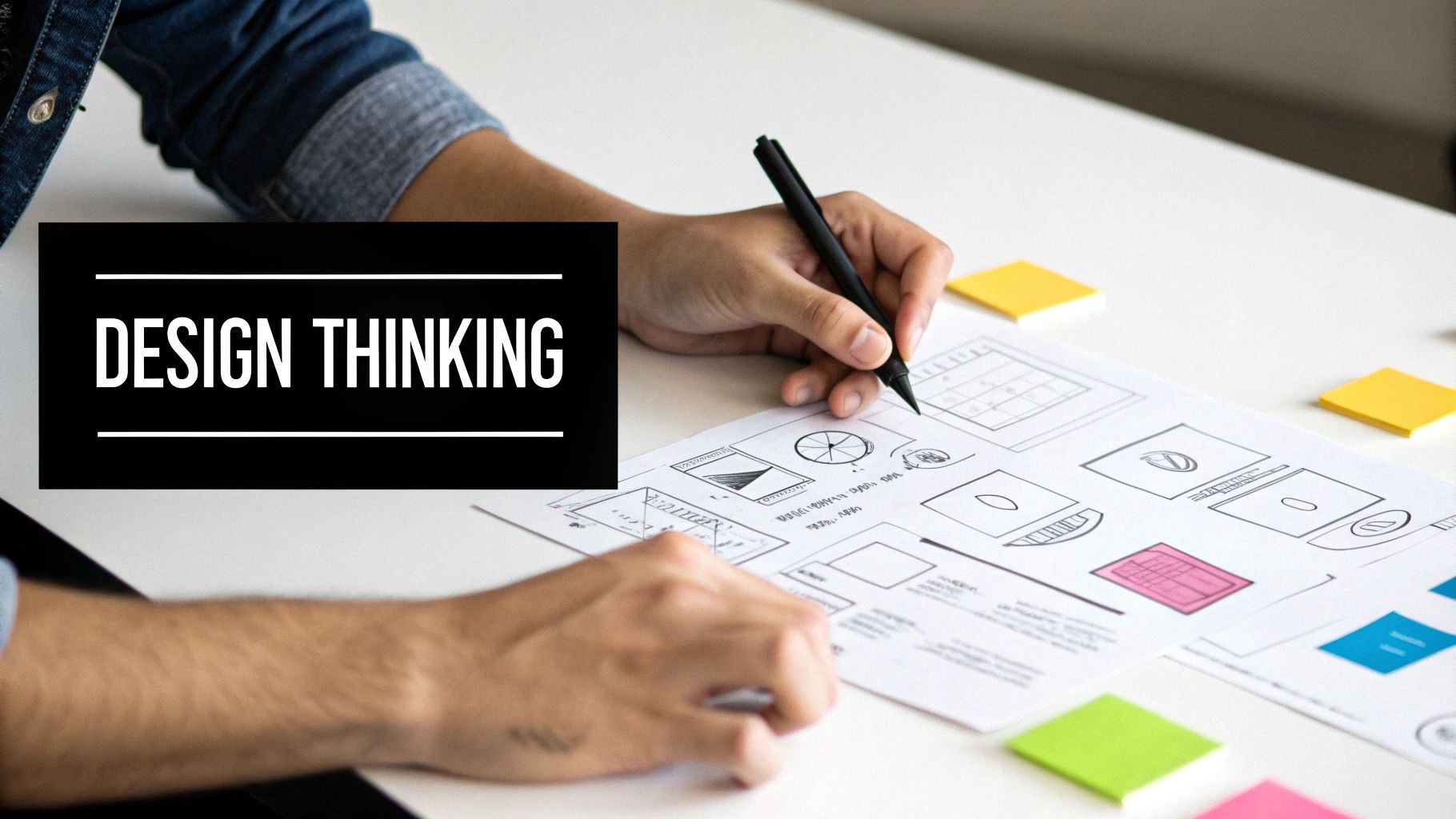
The primary goal is to develop deep user empathy to uncover unmet needs and latent desires. This empathetic foundation guides the entire problem-solving journey. Renowned companies like Apple use a design thinking philosophy to develop products that deeply resonate with customers, while healthcare organizations use it to redesign patient experiences, proving its versatility across industries. It frames problems around human experience, leading to more impactful innovations.
How to Implement Design Thinking Effectively
To make Design Thinking work, the process must be collaborative, hands-on, and focused on learning through doing. The cycle of prototyping and testing is central, allowing teams to fail early and inexpensively while gathering crucial feedback.
- Empathize and Define: Conduct genuine user research through interviews and observation to understand their pain points. Then, synthesize these findings into a clear, actionable problem statement.
- Ideate Widely: Generate a broad range of potential solutions without initial judgment. Use techniques like brainstorming and mind mapping to explore diverse possibilities.
- Prototype and Test: Create low-fidelity, inexpensive prototypes (like sketches or simple mockups) to make ideas tangible. Test these prototypes with real users to gather feedback and refine the solution.
- Iterate and Refine: Embrace feedback as a learning opportunity. The process is cyclical, so use insights from testing to loop back to earlier stages and improve the solution.
This iterative approach reduces the risk of building something nobody wants, ensuring the final product is well-aligned with user needs. To see how these stages fit together, you can explore this guide to planning a design thinking workshop.
3. SCAMPER
SCAMPER is a systematic checklist of creative problem solving techniques that prompts idea generation by asking targeted questions. Developed by Bob Eberle, this method uses a mnemonic to guide users through seven different ways to think about modifying an existing product, service, or process. The core principle is to use these action verbs as lenses to deconstruct a problem and uncover innovative solutions that might not be immediately obvious.
The goal is structured innovation over random ideation. By systematically applying each of the seven prompts (Substitute, Combine, Adapt, Modify, Put to another use, Eliminate, Reverse), teams can explore a problem from multiple angles. For example, Netflix Eliminated the need for physical video rental stores, while smartphones Combined the functions of a phone, camera, and computer into a single device. This methodical approach ensures a comprehensive exploration of possibilities.
How to Implement SCAMPER Effectively
To make SCAMPER more than just a checklist, it requires a facilitator to guide the team through each letter, ensuring all avenues are explored before moving to the next. The focus is on asking probing questions related to each action verb.
- Substitute: What components, materials, or people can you swap? For instance, can we use a sustainable material instead of plastic?
- Combine: How can you merge two or more parts of your product or service? Think about how a phone case was combined with a battery pack.
- Adapt: What other idea or concept could you adapt to solve your problem? YouTube adapted traditional broadcasting for individual content creators.
- Eliminate: What can you remove or simplify? Consider how minimalist designs remove non-essential visual elements.
- Reverse: How can you rearrange or reverse the process or product? For example, some restaurants have customers pay before they eat.
Once you have generated ideas for each category, you can begin the evaluation phase. This structured approach helps transform abstract thinking into tangible concepts. You can find a deeper analysis of SCAMPER and other creative problem solving methods here.
4. Six Thinking Hats
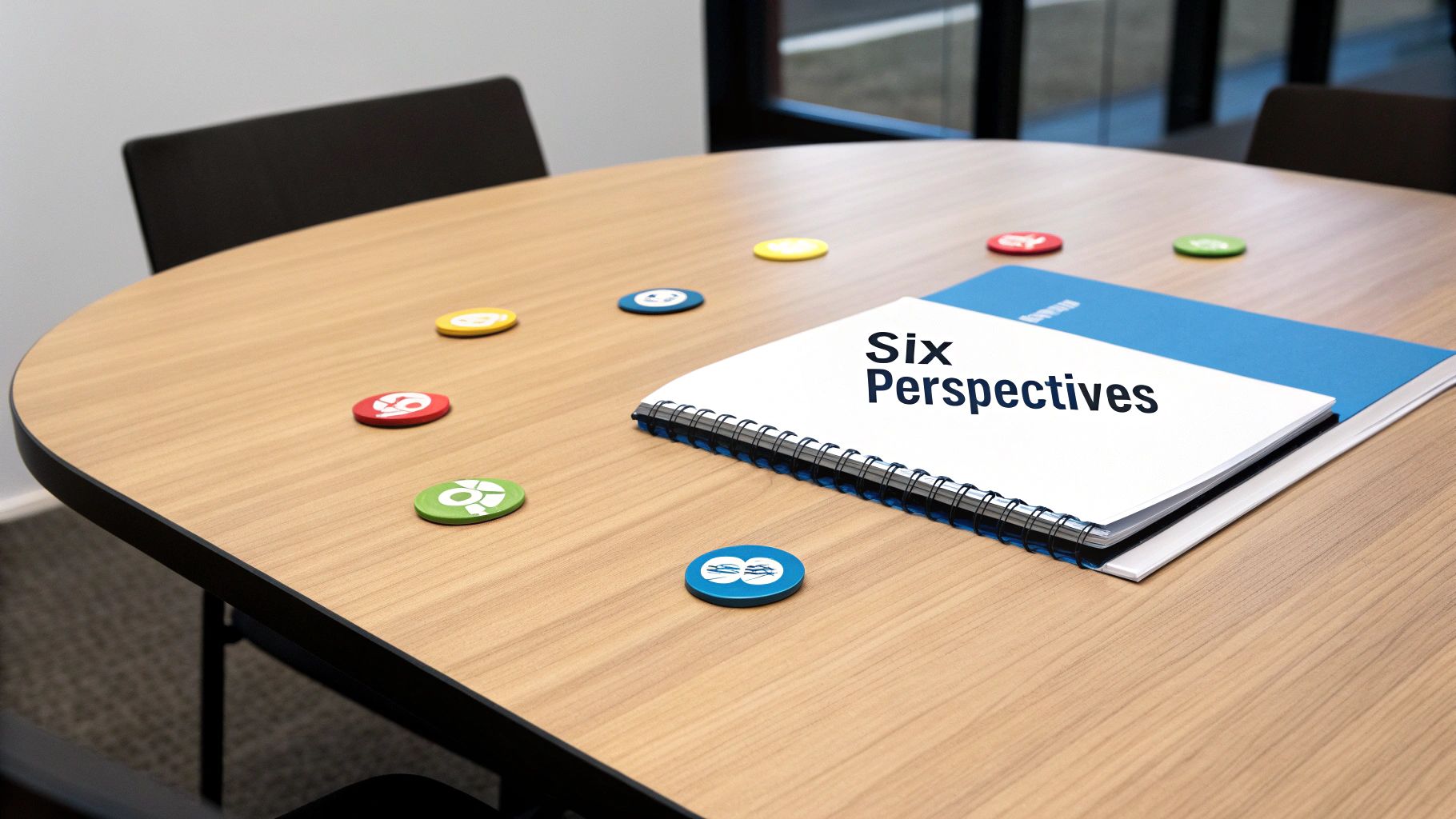
Six Thinking Hats is a powerful creative problem solving technique that facilitates parallel thinking by having group members metaphorically "wear" different colored hats, each representing a distinct mode of thought. Developed by Edward de Bono, this method separates thinking into six clear functions, allowing a team to analyze an issue from various perspectives simultaneously without conflict. Instead of defending a single viewpoint, everyone explores each angle together, moving from one hat to the next in a structured sequence.
The core goal is to decouple ego from performance. This structured approach prevents adversarial debates and encourages a more comprehensive, collaborative exploration of a problem. Major corporations and government bodies use this technique in strategic planning to ensure all facets of a decision, from the emotional to the data-driven, are considered thoroughly. By compartmentalizing thinking, it streamlines discussions and reduces the time wasted on unproductive arguments.
How to Implement Six Thinking Hats Effectively
A facilitator guides the group, announcing which hat is in use and ensuring everyone adheres to that mode of thinking. The Blue Hat (process) typically starts and ends the session to set the agenda and summarize outcomes.
- Define Hat Roles Clearly: Ensure everyone understands what each hat represents: White (facts), Red (emotions/intuition), Black (caution/risks), Yellow (optimism/benefits), Green (creativity/ideas), and Blue (process/control).
- Think in Parallel: The key is that everyone "wears" the same hat at the same time. This focuses the group's collective mental energy on one type of thinking.
- Follow a Sequence: A common sequence is Blue (agenda), White (data), Green (ideas), Yellow (benefits), Black (risks), and Red (feelings), concluding with Blue (summary).
- Enforce Hat Discipline: Gently redirect participants who stray from the current hat's thinking style. For example, if someone critiques an idea during the Green Hat phase, remind them to save it for the Black Hat.
This method transforms meetings from confrontational debates into collaborative explorations. It is also an excellent framework for structuring feedback sessions, which can be explored further in this guide on giving effective design feedback.
5. Mind Mapping
Mind Mapping is a powerful visual creative problem solving technique that organizes information radially around a central concept. Developed by learning expert Tony Buzan in the 1970s, it’s designed to mirror the brain's natural associative thinking process, using branches to link related ideas, subtopics, and connections. This non-linear approach helps uncover deeper relationships between concepts and frees the mind from the constraints of linear note-taking.

The primary goal is to visually structure information, making complex problems easier to comprehend and explore. For instance, marketing teams use mind maps to brainstorm campaign components, while software developers use them to plan application architecture. By externalizing thoughts onto a single page, teams can see the big picture and identify previously hidden opportunities or potential roadblocks. This method is exceptionally useful for organizing complex information, a key principle you can explore further in this guide to information architecture.
How to Implement Mind Mapping Effectively
To create a useful mind map, the process should be fluid and intuitive, allowing ideas to flow freely from a central point. Digital tools like MindMeister or XMind can facilitate this, but a simple pen and paper work just as well.
- Start with a Central Idea: Place your main problem or topic in the center of the page. This is the starting point for all associated thoughts.
- Use Keywords and Images: Use single, impactful keywords for your main branches. Add colors and simple images to make the map more memorable and stimulating.
- Branch Out Organically: Create main branches for major sub-topics, then add smaller "child" branches for related details. Let the structure evolve naturally.
- Make Connections: Use lines and arrows to connect ideas across different branches, highlighting relationships and fostering new insights.
After the initial creation phase, step back and analyze the map. This review often sparks new ideas and helps refine the solution by providing a clear, holistic view of the problem and its potential components.
6. Lateral Thinking
Lateral Thinking is one of the most transformative creative problem solving techniques, focused on approaching challenges from indirect and unconventional angles. Coined by Edward de Bono in his 1967 book of the same name, it rejects the traditional, step-by-step logic of vertical thinking. Instead, it encourages restructuring patterns, challenging assumptions, and seeking creative alternatives that are not immediately obvious. The goal is to escape established mental pathways to find novel solutions.
The primary aim is to generate new perceptions, not just refine existing ones. This method intentionally disrupts linear thought to provoke new ideas. For instance, using de Bono's "Random Word" technique, one might apply an unrelated word like "bicycle" to a business problem like "customer retention" to spark unexpected connections, such as creating a loyalty program with tiered "gears" or a cyclical feedback loop. This deliberate provocation is what makes lateral thinking a powerful engine for innovation.
How to Implement Lateral Thinking Effectively
Implementing lateral thinking requires a conscious effort to break free from comfortable, logical thought patterns. It's a skill that strengthens with practice, turning a rigid mindset into a more flexible and creative one.
- Challenge Assumptions: List every assumption you have about the problem and then deliberately question each one. Ask, "What if the opposite were true?" For example, if you assume customers want more features, ask what would happen if you offered fewer, simpler ones.
- Use Random Stimuli: Introduce a random word, image, or object into your problem-solving process. Force yourself to find connections between the random stimulus and your challenge to generate fresh perspectives.
- Reverse the Problem: Instead of asking "How can we achieve X?", ask "How could we make X worse?" or "How could we create the opposite of X?". Understanding how to cause a problem often reveals insights into how to solve it.
- Combine Unrelated Ideas: Take two completely different concepts and explore how they might be combined. This is how innovations like Twitter's character limit (combining micro-messaging and a creative constraint) or subscription-based meal kits emerged.
By deliberately sidestepping the logical path, lateral thinking opens up a vast space for breakthrough ideas that traditional problem-solving methods might never uncover.
7. The Five Whys
The Five Whys is a powerful interrogative technique used to explore the cause-and-effect relationships underlying a particular problem. This method, a critical component of the Toyota Production System, is one of the most effective creative problem solving techniques for moving beyond surface-level symptoms to uncover the root cause. By repeatedly asking "Why?" (typically five times), teams can drill down through layers of issues to find the foundational process or system failure that needs fixing.
The primary goal is root cause analysis, not simply addressing the immediate symptom. For instance, in healthcare, it's used to analyze adverse events, and in software development, it helps debug complex code by tracing an error back to its origin. This systematic approach prevents teams from implementing superficial fixes that allow the same problem to reoccur. It shifts the focus from a quick patch to a lasting systemic improvement.
How to Implement The Five Whys Effectively
A successful Five Whys session requires a facilitator to guide the questioning and maintain a blameless, process-focused environment. The aim is to understand the breakdown in a system, not to assign fault to individuals.
- Define the Problem: Start with a clear and concise problem statement. For example, "The new marketing campaign had a 20% lower conversion rate than projected."
- Ask "Why?" Sequentially: Ask why the problem occurred. Once you have an answer, ask "Why?" again about that answer. Continue this process until the root cause becomes apparent.
- Focus on Processes, Not People: Frame questions around systems and processes. Instead of "Why did the designer make a mistake?", ask "Why did the design review process not catch the error?".
- Document and Verify: Write down each answer clearly. The final "why" should lead to a process that, when changed, will prevent the initial problem from happening again. Involve team members from different departments to gain a complete perspective.
This disciplined questioning prevents wasted effort on solving the wrong problem. It ensures that solutions are directed at the core issue, leading to more robust and sustainable outcomes.
8. Morphological Analysis
Morphological Analysis is one of the more systematic creative problem solving techniques, developed to explore all possible solutions to a complex, multi-dimensional problem. Created by Swiss astrophysicist Fritz Zwicky in the 1940s, this method involves breaking a problem down into its core parameters or attributes and then listing all possible variations for each one. By creating a matrix of these combinations, you can systematically uncover novel and unexpected solutions that might otherwise be overlooked.
The primary goal is comprehensive exploration over intuitive leaps. It forces you to look beyond the obvious answers by methodically mapping out the entire "solution space." This structured approach is highly effective for complex challenges like new product development or business model innovation, where multiple variables must work together. For example, it could be used to design a new type of space exploration vehicle by combining all possible propulsion systems, fuel types, and navigation methods.
How to Implement Morphological Analysis Effectively
To get the most out of this technique, structure is paramount. The process moves from deconstruction to systematic combination, ensuring no stone is left unturned.
- Define Key Attributes: Identify the fundamental components of the problem. For a new service, these might be "Delivery Method," "Pricing Model," "Customer Support," and "Key Features." Aim for 2-7 critical dimensions.
- List Variations: Under each attribute, list as many variations as possible. For "Delivery Method," this could include "In-person," "Online Portal," "Mobile App," or "Subscription Box."
- Create a Matrix: Organize the attributes and their variations in a grid or table. This visual matrix, often called a "Zwicky Box," allows you to see all potential combinations clearly.
- Explore Combinations: Systematically work through the matrix, combining one variation from each attribute column to form a potential solution. Even unlikely pairings can spark innovative ideas.
After generating a list of all feasible combinations, you can begin the evaluation process. This methodical framework ensures you have considered a vast range of possibilities, dramatically increasing your chances of finding a breakthrough solution.
9. The Disney Creative Strategy
The Disney Creative Strategy is one of the more structured creative problem solving techniques, modeling the genius of Walt Disney’s own process. Popularized by neuro-linguistic programming expert Robert Dilts, it separates the creative process into three distinct, sequential roles: the Dreamer, the Realist, and the Critic. This method ensures that imaginative ideas are not prematurely dismissed but are instead methodically refined into actionable plans.
The core goal is to harmonize vision with practicality. By adopting each persona in turn, you give unbridled imagination a chance to flourish before subjecting it to pragmatic planning and objective evaluation. This prevents the "Critic" from stifling the "Dreamer" too early. Companies like Pixar use a similar phased approach to develop story concepts, allowing wild ideas to be explored fully before logistical and quality control filters are applied.
How to Implement the Disney Creative Strategy Effectively
This technique requires disciplined role-playing, where each phase is given its own dedicated time and space. The facilitator’s role is to ensure participants stay in character and that the process flows from one stage to the next without overlap.
- Embody the Dreamer: In this first phase, think without limits. The only question is "What if?". Generate as many visionary and imaginative ideas as possible, no matter how outlandish they seem.
- Become the Realist: Next, shift to a practical, action-oriented mindset. Ask "How can we make this happen?". Develop a step-by-step plan, identify required resources, and create a realistic timeline for the Dreamer's ideas.
- Engage the Critic: Finally, approach the Realist's plan with a constructive, objective eye. Ask "What could go wrong?" and "How can we improve this?". Identify potential weaknesses, risks, and missing pieces, not to kill the idea but to strengthen it.
By following this Dreamer → Realist → Critic sequence, teams can protect innovative concepts through a rigorous process of planning and refinement, transforming ambitious visions into robust, well-vetted strategies.
10. Reverse Brainstorming
Reverse Brainstorming is a powerful counter-intuitive creative problem solving technique that flips the traditional approach on its head. Instead of asking "How do we solve this problem?", the team asks, "How could we cause this problem?" or "How could we make this problem worse?". This deliberate focus on failure and negative outcomes helps uncover hidden risks, assumptions, and potential roadblocks that might otherwise be overlooked.
The primary goal is proactive problem prevention and identification. By intentionally thinking about what could go wrong, teams can anticipate obstacles and develop more robust solutions. This method is frequently used in quality improvement frameworks like Six Sigma and in risk management to identify potential project failures before they happen. For example, a marketing team might ask, "How can we lose all our customers?" to pinpoint weaknesses in their current retention strategies.
How to Implement Reverse Brainstorming Effectively
This technique requires a shift in mindset from solution-focused to problem-focused thinking. A facilitator is crucial to guide the group through the process of identifying negative causes and then reversing them into positive actions.
- Define the Problem in Reverse: Clearly state the problem you want to cause or worsen. For instance, instead of "How do we improve product quality?", ask "What are all the ways we could maximize product defects?".
- Generate Causes: Brainstorm all the potential causes that would lead to this negative outcome. Encourage a high volume of ideas without judgment, just as in traditional brainstorming.
- Reverse the Causes into Solutions: Systematically go through the list of negative causes and rephrase each one as a positive solution. A cause like "Use low-quality materials" becomes the solution "Source and use only high-quality materials."
- Evaluate and Prioritize: Analyze the resulting list of solutions. This process often reveals innovative and practical ideas that were not obvious when approaching the problem directly.
Comparison of 10 Creative Problem-Solving Techniques
| Method | 🔄 Implementation Complexity | ⚡ Resource & Time | ⭐ Expected Effectiveness | 📊 Ideal Use Cases | 💡 Key Advantages / Tips |
|---|---|---|---|---|---|
| Brainstorming | Low–Medium — simple setup; facilitator recommended | Low — short sessions (15–30 min) | ⭐⭐⭐ — high volume, variable quality | Early ideation, team engagement, quick idea dumps | Enforce no-criticism; timebox; document all ideas |
| Design Thinking | High — multi-phase, iterative process | High — user research, prototyping, cross-functional time | ⭐⭐⭐⭐ — user-aligned, reduces development risk | User-centered product/service design, complex UX problems | Prototype early; include diverse perspectives; test often |
| SCAMPER | Low — structured checklist approach | Low — quick prompts; easy to run | ⭐⭐⭐ — practical, incremental improvements | Iterative product/service improvements, feature ideation | Apply each letter systematically; combine strategies |
| Six Thinking Hats | Medium — requires training and facilitation | Medium — timed role-based sessions | ⭐⭐⭐⭐ — ensures multiple perspectives, reduces conflict | Strategic planning, decision workshops, group discussions | Train participants; use colored props; follow a sequence |
| Mind Mapping | Low — easy to start; practice improves skill | Low — fast capture; scalable for detail | ⭐⭐⭐ — great for organization, recall and connections | Planning, note-taking, mapping relationships and concepts | Start with a clear central idea; use keywords and color |
| Lateral Thinking | Medium–High — needs practice and mindset shift | Medium — time for provocation and exploration | ⭐⭐⭐⭐ — strong breakthrough potential, less immediate feasibility | Breakthrough ideation, reframing entrenched problems | Use random stimuli; challenge assumptions regularly |
| The Five Whys | Low — simple iterative questioning | Low — quick sessions, minimal resources | ⭐⭐⭐ — effective for single-root causes; limited for multi-causal | Root-cause analysis, troubleshooting, process failures | Be blameless; focus on systems/processes; document answers |
| Morphological Analysis | High — matrix-building and combination work | High — time‑intensive; may need tools for large sets | ⭐⭐⭐⭐ — comprehensive exploration, many alternatives | Complex product design, multi-attribute innovation, systems design | Limit dimensions (2–7); use software for large matrices |
| The Disney Creative Strategy | Medium — role switching and sequencing | Medium — requires time/space for each persona | ⭐⭐⭐⭐ — balances creativity with feasibility | Creative projects needing practical planning and critique | Separate spaces/roles; follow Dreamer → Realist → Critic |
| Reverse Brainstorming | Low–Medium — inversion framing and facilitation | Low–Medium — engaging but needs reversal step | ⭐⭐⭐ — uncovers hidden risks and prevention strategies | Risk identification, customer experience improvement, QA | Frame the negative clearly; systematically reverse suggestions |
From Technique to Transformation: Putting Creativity into Practice
We've journeyed through a powerful arsenal of ten distinct creative problem solving techniques, from the structured inquiry of the Five Whys to the imaginative role-playing of the Disney Creative Strategy. Each method, whether it's the systematic deconstruction of SCAMPER or the holistic empathy of Design Thinking, offers a unique lens through which to view challenges and uncover hidden opportunities. While the tools themselves are potent, their true value is unlocked not by simply knowing them, but by actively and consistently applying them.
The journey from a theoretical understanding to practical mastery is where real innovation is born. These frameworks are not rigid prescriptions but flexible guides designed to break you out of conventional thought patterns. They provide the structure necessary to navigate ambiguity and the creative friction required to spark groundbreaking ideas. The ultimate goal is to move beyond seeing problems as frustrating roadblocks and start viewing them as invitations to innovate.
Your Action Plan for Creative Mastery
So, where do you begin? The key is to start small and build momentum. Don't feel pressured to implement all ten techniques at once. Instead, focus on integrating one or two into your existing workflow.
- Identify a Current Challenge: Pinpoint a specific, manageable problem your team is currently facing. Is it a dip in customer engagement? An inefficient internal process? A product feature that isn't landing well?
- Select the Right Tool: Review the techniques we’ve covered. If your problem is ill-defined, Design Thinking might be the perfect starting point. If you have an existing product that needs improvement, try applying the SCAMPER method. For a complex decision involving multiple perspectives, the Six Thinking Hats can provide invaluable clarity.
- Commit to the Process: Schedule a dedicated session and guide your team through the chosen method. Treat it as an experiment. The first attempt may not yield a perfect solution, but it will build the creative muscles necessary for future success.
- Reflect and Iterate: After the session, discuss what worked and what didn't. Did the technique help generate novel ideas? Did it uncover new insights? This reflective practice is crucial for refining your approach and building a team-wide creative competency.
Building a Culture of Innovation
Mastering these creative problem solving techniques does more than just solve individual problems; it fundamentally transforms your organization's culture. When teams are equipped with a shared language and toolkit for innovation, they become more resilient, adaptable, and engaged. A challenge is no longer a source of stress but an opportunity to collaborate and create something new.
By embedding these practices into your daily operations, you cultivate an environment where curiosity is encouraged, diverse perspectives are valued, and experimentation is the norm. This proactive approach to problem-solving becomes a significant competitive advantage, enabling your business to pivot faster, serve customers better, and consistently stay ahead of the curve. The result is a sustainable engine for growth, driven by the collective creativity of your team.
Ready to turn your innovative ideas into tangible results? Sometimes, the best solution involves bringing in a fresh perspective. Creativize connects you with a network of vetted, local creative professionals, from strategists and designers to content creators, who are experts at turning complex problems into compelling brand stories. Find the perfect partner to help execute your vision by visiting Creativize today.