
Your job search as a creative director lives and dies by your portfolio. This isn't just a slick gallery of your greatest hits anymore. Think of it as a strategic pitch document, one that has to prove your leadership chops, your business mind, and your vision. The whole game is shifting from showing what you made to explaining what you led.
Build a Portfolio That Screams Leadership

Let's be real: your portfolio is the single most important piece of this puzzle. When you’re gunning for a director role, hiring managers and execs are looking way past beautiful design. They need to see your ability to untangle complex business problems, fire up a team, and deliver results that actually move the needle.
The fundamental mindset shift is from "maker" to "leader." A maker's portfolio is all about technical skill and killer aesthetics. A leader's portfolio tells a story—a story of strategy, process, and bottom-line impact. Every single project has to be a compelling case study that answers the big "so what?" for the business.
From Pretty Pictures to Strategic Wins
First things first, take a hard look at your current portfolio. Does it feel like a highlight reel from a top-tier senior designer, or does it articulate the strategic thinking of a director? If it’s the former, it’s time for a reframe.
Every project needs a clear narrative. I like to think of it as a simple three-act play: the problem, the process, and the payoff.
- The Business Challenge: Kick things off by clearly defining the problem you were hired to solve. Was it cratering market share? Lousy brand engagement? A botched product launch?
- Your Strategic Approach: This is where you really get to shine as a leader. What was your unique insight? How did you diagnose the root issue? Walk them through your creative vision and the strategic why behind it. Detail how you steered your team through the trenches of brainstorming, concepting, and development.
- The Tangible Results: You have to end with cold, hard numbers. Don't just say a campaign was "successful." Give them metrics. We’re talking "increased web traffic by 35%," "boosted sales by $2M in the first quarter," or "improved brand sentiment by 20 points."
The real gap between a senior creative and a creative director is the ability to draw a straight line from creative execution to business goals. Your portfolio has to make that connection impossible to ignore. It needs to show you're not just making assets; you're driving growth.
Demonstrating Leadership in Every Project
You have to get specific about your contribution. It’s so easy for your role to get swallowed up in vague "we did this" language. You need to explicitly state what you did to lead the charge.
Switch to action-oriented phrasing that puts your directorial skills front and center. Instead of "the team created," try "I directed the team to…" or "My strategic insight led to…" This isn't about hogging the credit; it's about providing clarity on how you guided the outcome.
And don't forget to flex any specialized expertise. With over 40% of creative managers hiring contractors to fill skill gaps, showing you can confidently lead projects in high-demand areas like UX and UI makes you a much more attractive—and valuable—candidate.
To really nail this, you need to re-evaluate how you present every piece of your work. The goal is to shift the narrative from hands-on execution to high-level strategic direction.
Portfolio Content Framework From Maker to Leader
This table breaks down the subtle but critical changes in language and focus that elevate your portfolio from that of a senior creative to a true creative director.
| Portfolio Element | Execution-Focused Approach (What to Avoid) | Leadership-Focused Approach (What to Do) |
|---|---|---|
| Project Intro | "Here is a logo I designed for a tech startup." | "I led the rebranding of a SaaS startup to reposition them for a new enterprise market, addressing their 15% user churn." |
| Process | "I used Figma and Adobe Illustrator to create the assets." | "I directed a team of three designers, guiding them from initial concept workshops to final asset delivery over a six-week sprint." |
| Your Role | "I was responsible for the final design." | "My role was to establish the core brand strategy, mentor the junior designers, and present the final vision to the C-suite." |
| Results | "The client was very happy with the final product." | "The rebrand led to a 40% increase in demo requests and was featured in three major industry publications." |
By fully embracing this leadership-focused framework, you’re giving hiring managers the proof they desperately need to see. You're no longer just showing them cool work; you're proving you have what it takes to lead their creative department to victory.
To see how some of the best in the business put this into practice, check out our roundup of inspiring creative portfolio examples.
Your Resume and LinkedIn Are Two Sides of the Same Story
A killer portfolio gets your foot in the door, but it’s your resume and LinkedIn profile that keep you in the room. In a tight race for a creative director role, these documents can’t just be a dry rundown of your past jobs. They need to team up, telling a single, cohesive story about your leadership, your vision, and what makes you you.
Think of your resume as a marketing doc, not a historical record. Its one job? Get you the interview.
That top third of the page is prime real estate. This is where you need a compelling summary that skips the generic fluff like "results-oriented creative director." Instead, nail down your leadership philosophy in a few powerful sentences.
Are you the kind of director who mentors junior talent into an award-winning machine? Or are you the strategist who can spin a fledgling startup into an iconic brand? Your summary should immediately answer the hiring manager's big question: "What kind of creative leader am I looking at?"
Weave Keywords and Metrics into Your Narrative
Before you write a single word, pull up two or three job descriptions for roles you'd actually want. Hunt for the recurring keywords and phrases—you'll see things like "brand stewardship," "omnichannel campaigns," "team mentorship," or "data-driven creative." These are the keys that unlock the Applicant Tracking System (ATS) and get human eyes on your work.
Your mission is to thread these keywords naturally through your experience, turning passive duties into active wins. And please, quantify everything. Vague statements are a dead end; hard numbers show your real-world impact.
-
Don't say: "Managed a creative team."
-
Instead, try: "Led and mentored a team of 8 designers and copywriters, cutting project turnaround time by 25%."
-
Don't say: "Worked on a rebranding project."
-
Instead, try: "Directed a full-scale company rebrand that drove a 40% spike in social media engagement and a 15% lift in qualified leads."
This small shift turns your resume from a simple list of responsibilities into a highlight reel of strategic victories. It’s all about crafting a compelling narrative, which is really about learning how to tell your story using the DASH Method—a skill that's just as vital in an interview as it is on paper.
Make Your LinkedIn Profile Work for You
Your LinkedIn profile is the other half of this story. It’s where you can expand on what your resume introduces, adding a dose of personality and some valuable social proof. Your headline is your digital handshake, so it needs to do more than just state "Creative Director."
Give something like this a shot: "Creative Director | Building Brands That Resonate & Teams That Thrive" or "Creative Director Specializing in Tech & SaaS Brand Storytelling." It immediately signals your focus and your leadership vibe.
Your "About" section is your chance to really open up about your leadership philosophy. Talk about how you build a great team culture, how you inspire creativity, and how you connect the work back to real business goals. Keeping your voice consistent across all your professional platforms is crucial—treat it just like you would when building out brand voice guidelines for a client.
Don't be afraid to ask for recommendations. Seriously. Reach out to old bosses, people who reported to you, and key collaborators. Give them a little nudge by asking them to talk about a specific project or a quality you're proud of, like your mentorship style or how you navigated a tough client situation. These testimonials are gold—they're third-party validation that you are who you say you are.
When you treat your resume and LinkedIn as two chapters of the same book, you create a powerful, consistent narrative. You’re showing hiring managers not just what you've done, but exactly the kind of leader you'll be for their team.
Find and Engage the Right Opportunities
The best creative director roles are almost never found on huge, impersonal job boards. Let's be real—the most transformative opportunities are won through smart, targeted outreach, not by endlessly clicking "apply." Your next big move is more likely to start in a DM than on a generic career site.
Winning this game means showing up where other creative leaders hang out. Platforms like LinkedIn, Behance, and other industry-specific hubs are your new hunting grounds. But just lurking isn't enough; you've got to participate. Think of your job search as a campaign: identify your dream companies and the people leading their creative, then map out a genuine way to connect.
Look Beyond the Obvious Job Boards
First thing's first: you need to expand your search beyond the usual suspects. While the big job sites have their place, the real gems—the high-impact, high-reward roles—are often found elsewhere.
- Go Deep on LinkedIn: Forget just the "Jobs" tab. If you have LinkedIn Premium, fire up Sales Navigator. Use it to pinpoint key decision-makers like VPs of Creative or CMOs at companies you admire. Following their posts and activity gives you an inside track on what they care about, their team's culture, and potential needs long before a job is posted.
- Hang Out in Niche Communities: Every creative discipline has its own watering hole. For product design, it's Dribbble. For packaging, it's The Dieline. For the ad world, it's Adweek. These are the places where employers go when they're looking for specialized, top-tier talent.
- Partner with Creative Recruiters: Don't write off a great recruiter. The good ones have exclusive access to roles that never see the light of day. They're often the gatekeepers for confidential searches. We put together a guide on the best creative staffing agencies to help you find a partner who actually gets what you do.
This proactive approach is crucial because the CD role itself has evolved so much. It's no longer just about aesthetics. Today, you're expected to live at the intersection of brand strategy, content, and digital execution. As marketing gets more and more fragmented, companies are desperate for leaders who can create a cohesive vision across a dozen different channels. The BLS.gov data on art directors confirms this trend toward more strategic leadership.
The Art of the Non-Transactional Outreach
Once you’ve got a list of people you want to connect with, the real work starts. The goal is to start a conversation, not to immediately ask for a job. A cold, "Can I have a job?" message is a surefire way to get ignored. You need to build a real connection first.
Make your outreach personal and add value. Did a creative director you look up to just launch a killer campaign? Shoot them a note and mention one specific detail that blew you away. Did a company on your list publish a really insightful article? Share it with a thoughtful comment.
The golden rule of networking is simple: give before you get. Share something helpful. Offer a genuine compliment. Make an introduction. Build your network on a foundation of generosity, and people will be far more willing to help when you finally make an ask.
A Practical Outreach Example
Here’s a simple, adaptable script. Notice it's specific, respectful of their time, and opens the door for a conversation without making a demand.
"Hi [Name],
My name is [Your Name], and I'm a Creative Director specializing in [Your Niche]. I've been following [Their Company]'s work for a while, and the recent [Specific Project] campaign was just fantastic. The way your team [Mention a Specific Detail] was brilliant.
I know how busy you must be, but if you ever have a spare 15 minutes in the coming weeks, I'd love to briefly hear a bit about your journey leading the team there.
Best,
[Your Name]"
This turns your job search from a passive, frustrating experience into an active, strategic campaign. By sourcing opportunities with intention and engaging people like a human, you tap into the hidden job market—and that's where the best roles are always hiding.
Navigate the Creative Director Interview Process
The interview process for a Creative Director role isn't just a Q&A session. Think of it more like an audition—you’re trying out for the part of visionary, strategist, and leader, all rolled into one. It’s your shot to bring your portfolio to life and show them your leadership presence in real-time.
Nailing it means being ready for every single stage, from that first call with a recruiter to the final, high-stakes presentation. You’ll be talking to a lot of different people, and each one needs to hear a slightly different version of your story.
This whole journey, from finding the right roles to landing the offer, is an active process. It’s about being proactive, not just waiting for things to happen.
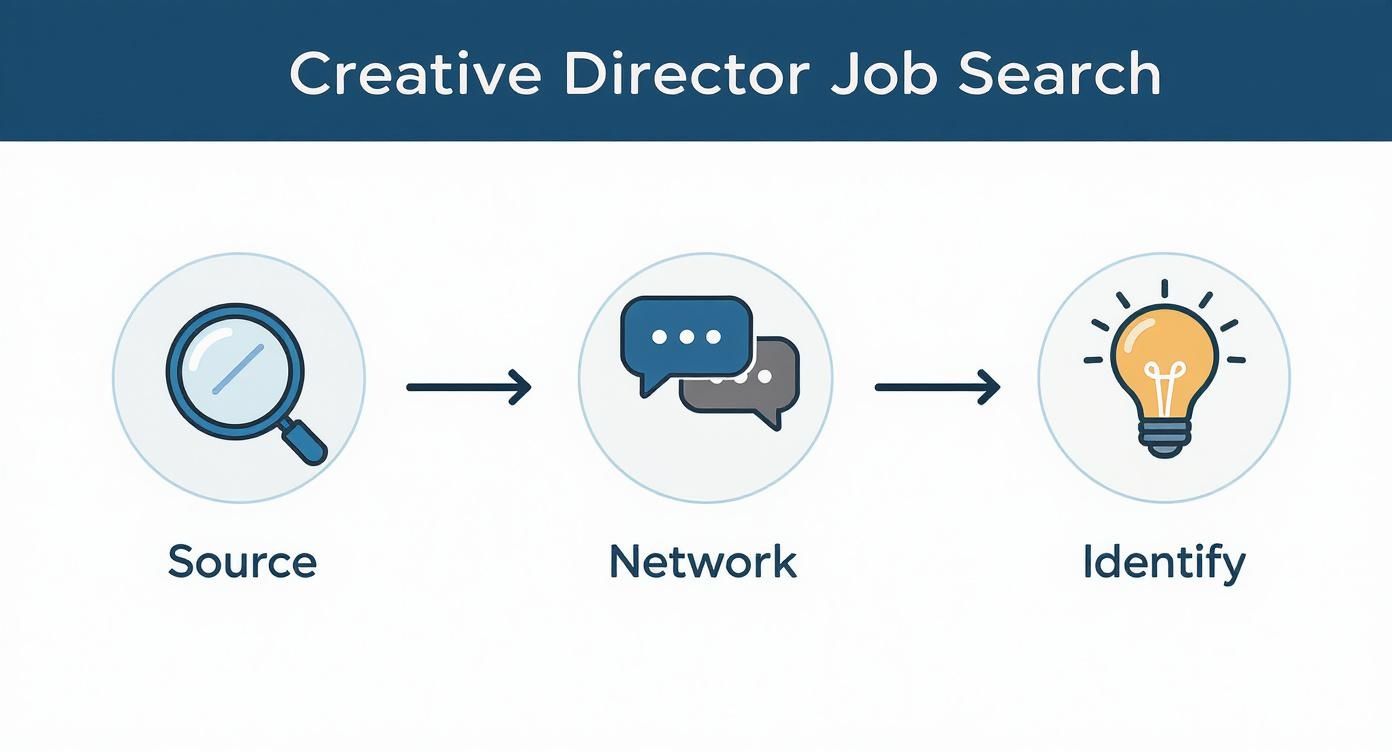
As you can see, getting the interview is the payoff for all the hard work you put in sourcing opportunities and building real connections. It’s rarely about just hitting "apply."
Reading the Room: Handling Different Interviewers
You’re not going to be talking to just one person. A solid interview process will have you meeting a whole cross-section of the company, and trust me, each of them is listening for something different. You’ve got to tune your message to what they care about most.
Speaking to different stakeholders requires shifting your focus. The way you talk to the CEO about vision is completely different from how you'll connect with the creative team on process. I've found it helpful to map out their likely concerns ahead of time.
Creative Director Interview Stakeholder Focus
| Interviewer | Their Primary Concern | Your Strategic Focus |
|---|---|---|
| Recruiter / HR | "Are you qualified? Are you in our budget? Are you a culture fit?" | Your concise career narrative. Deliver a powerful elevator pitch about your leadership philosophy and be ready to talk salary ranges. |
| Hiring Manager | "Can you solve my business problems? Are you a strategic partner?" | Your strategic brain. Ask smart questions about their challenges. Connect your past wins directly to their current needs. |
| The Creative Team | "Would we want to work for you? Do you get our process?" | Your mentorship style. Show them you’re a leader they can learn from. Talk about how you give great design feedback to build trust. |
| CEO / Founder | "Do you understand the big picture? Can you drive growth?" | Vision and business impact. Frame everything in terms of the company's mission and how your creative strategy will fuel growth. |
Being able to connect your creative wins to business goals is a superpower. When you’re talking to a CEO or a Head of Sales, frame your successes in their language—revenue, market share, and customer acquisition.
Your ability to connect with non-creatives is just as important as your ability to inspire a design team. When you're talking to a CEO or a Head of Sales, frame your creative wins in the language of business—revenue, market share, and customer acquisition.
Telling Leadership Stories That Actually Land
When you get hit with behavioral questions like, "Tell me about a time you dealt with a difficult client," don't just wing it. A generic answer won't cut it. The STAR method is a classic for a reason—it gives your answers a narrative structure that’s easy to follow and hard to forget.
Here’s how it works:
- Situation: Set the scene, but keep it brief. What was the project and the core challenge? (e.g., "We were on a tight deadline for a huge product launch, and the client dropped some last-minute, conflicting feedback on us.")
- Task: What was your specific job in that mess? (e.g., "I had to get the client aligned, protect my team from burning out, and somehow still deliver a killer campaign on time.")
- Action: This is the hero moment. What did you do? Get specific. (e.g., "I called an emergency meeting, walked them through three revised options based on their core notes, and laid out the pros and cons of each. Then, I re-prioritized the team’s work so they could focus solely on the chosen path.")
- Result: What happened in the end? Slap a number on it if you can. (e.g., "The client felt heard and signed off on the new direction that afternoon. We launched on time, and the campaign beat its lead generation goal by 20%.")
Using this framework turns a simple answer into a mini-case study that proves you can lead.
Nailing the Creative Challenge
Ah, the take-home assignment. It’s often the final boss of the interview process. They aren’t just looking for a cool idea; they're testing your strategic process, how you present, and how you think on your feet.
First things first: clarify the expectations. Ask how much time they really expect you to spend, what the deliverables are, and who you’ll be presenting to. A company that doesn’t respect your time now probably won’t later.
When you present, don't just show the final work. Spend just as much time explaining your "why." Start by reframing the business problem as you see it, then walk them through your strategic thinking. Show them how your creative solution is a direct answer to that problem. That's what separates a director from a designer.
Negotiate the Compensation You Deserve
Getting the job offer is a massive win. It’s the proof you need that your portfolio, your story, and your interview performance all landed perfectly. But don't pop the champagne just yet—this is the final mile, not the finish line.
The conversation you're about to have can literally change your financial future and how happy you are in the role.
Remember, negotiation is expected. It’s a totally normal part of the hiring game for senior roles like this. Handling it with confidence shows you know your worth, which is exactly the kind of leadership trait they're looking for.
Know Your Numbers Before You Talk
Walking into a salary negotiation without data is like showing up to a creative review without a brief. You need a rock-solid foundation of research to back up what you're asking for. The goal is to anchor the discussion in facts, not just what you feel you deserve.
Start by digging into the market rate for a Creative Director with your specific experience, in your industry, and in your city. The average salary for a Creative Director in the U.S. hovers around $139,000 a year, but that number can swing wildly from $120,000 to over $215,000.
Since almost half of hiring managers are bracing for a tough time meeting salary expectations, coming in with a realistic, data-backed range is your biggest advantage.
- Think beyond the base salary. Total compensation is more than just your paycheck. You need to look at the whole picture: performance bonuses, stock options, a signing bonus, PTO, and benefits.
- Factor in the role’s scope. Are you leading a team of two or twenty? Building a department from scratch or taking over a well-oiled machine? Bigger responsibility should always mean bigger compensation.
A huge mistake I see people make is getting fixated on the base salary. A slightly lower base with a killer performance bonus and some equity could be way more valuable in the long run. Get the complete picture before you make a move.
Handling the "Salary Expectations" Question
This question always seems to pop up early in the process. Answer it wrong, and you can box yourself in. But if you sidestep it gracefully, you keep all your options open. The best play here is to avoid naming a specific number for as long as you possibly can.
Instead of throwing out a number, try something like this:
"I'm really focused on finding the right fit, and I’m confident we can land on a competitive salary once we've both decided I'm the best person for the role. Could you tell me more about the approved salary range for this position?"
This flips the question right back to them, but in a totally professional way. It shows you're flexible but also signals that you expect an offer that matches the responsibilities you're still learning about.
Building Your Counter-Offer Case
Once that offer is in your inbox, it's time to play your cards right. The key is to always lead with genuine excitement for the role before you start talking numbers. If you want a deep dive on the mechanics, there’s a fantastic step-by-step guide on how to negotiate a job offer that walks through the whole thing.
Your counter-offer shouldn't sound like a list of demands; it needs to be a compelling business case. Connect your request directly to the value you'll bring to their specific problems.
Here’s an example of a powerful argument:
"Thank you so much for the offer! I am absolutely thrilled about the opportunity to lead the creative team at [Company Name]. Based on our talks about expanding into the B2B market, and my direct experience leading a similar project that grew revenue by 30%, I believe compensation in the [Your Target Range] range would be a better reflection of the value I'll bring."
See what that does? It reframes the whole conversation around mutual benefit. You’re not just asking for more cash; you’re reminding them of the massive ROI they're about to get. Stay professional, stick to the data, and keep the focus on value. That’s how you secure the compensation you've earned.
Your Creative Director Job Search Questions, Answered
Look, searching for a CD role is its own beast. It comes with a unique set of questions and a whole lot of "is this normal?" moments. Let's tackle some of the most common hurdles you'll probably face.
How Long Is This Really Going to Take?
This is the million-dollar question, isn't it? The honest-to-god answer is: it depends. Landing a senior leadership gig isn't a quick process. You should mentally prepare for a timeline of anywhere from three to six months. Sometimes even longer, depending on how specific you're being and what the market's like.
You're not just sending out a resume and getting a call. You've got recruiter screens, deep-dive interviews with a whole cast of characters, and usually a final creative presentation to prep for. Patience is your best friend here.
Seriously, don't get discouraged if things feel slow. A longer search often means the company is being incredibly selective. That's a good thing. Use the downtime to keep polishing your book, connect with people, and walk into every interview stage with a clear head.
Should I Freelance While I’m Looking for a Full-Time Gig?
If you've got the bandwidth for it, absolutely. Taking on some freelance or contract work while you're on the hunt is a brilliant move. It keeps your skills sharp and, more importantly, keeps your portfolio from getting stale.
Plus, it shows hiring managers you’re still in the game, which is a huge plus. It also helps pay the bills, taking some of the financial pressure off a long search. You never know—sometimes those freelance gigs turn into the full-time role you were looking for all along. For more ideas, our guide on how to find a gig can help you keep the momentum going.
Is It Okay if I’m Having Second Thoughts About My Career Path?
Let me be crystal clear: it is 100% okay to change your mind. Tons of creative directors hit a point where they realize the agency grind or the in-house role they chased for years just isn't it anymore. That’s not failure. It’s evolution.
If you’re feeling burnt out or just plain uninspired, that’s your gut telling you something needs to change. All that experience you've gained as a creative leader is gold. You can apply it to so many other things—starting your own shop, consulting, teaching, or even jumping into a totally different creative field. Give yourself permission to redefine what success looks like now. Your knack for creative problem-solving will get you wherever you want to go next.
Ready to find your next great local creative partner? At Creativize, we connect businesses with top-tier talent right in their community. Discover vetted creative professionals and bring your vision to life.